Sunday, April 24, 2011

Easter Weekend Bass

Saturday of easter weekend was almost a wash.  I woke up to rain and wind and fishing didn't seem like an option.  I made some coffee and sat down at the vise to tie some flies I have had in my head.  I tied a half dozen "mushmouths", a pattern by Dave Skok, a well known New England fly tier, fly fisherman and photographer. I added a couple clouser minnows to the done pile and took a ride to bass pro shops in Foxboro to kill time and restock on thread. 

I drove back to CT for the evening and got back with just enough time for my brother and I to fish a local lake for the last hour or so of light. We went old school and fished from a canoe with not much besides two spinning rods and a few lures.  Bill had all the success, landing 3 smallmouth bass, all on a small crankbait.

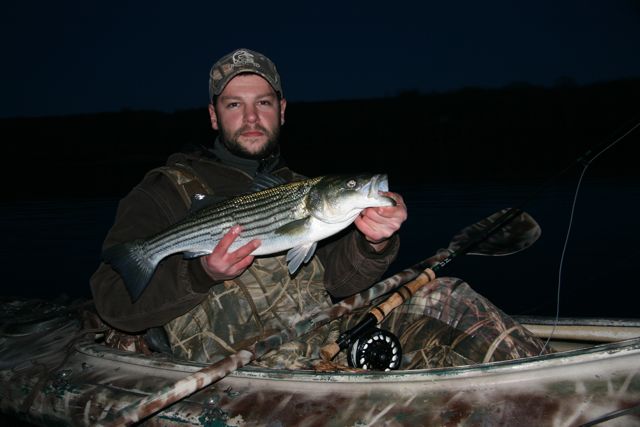
By 5 am this morning we were hitched up to our friend Chris's boat and heading south along the river to Old Saybrook.  We launched in a dense fog that never lifted and headed to a few early season schoolie haunts after hearing reports that they were here.  The water was high, filled with debris, and a chocolaty brown color.  It was a slow ride south and without a compass and gps, we might still be out there! Spot number one yielded no results, we didn't even see fish spook off the shallow flats like we normally would when they arive.  Spot two brought a quick bite for Bill, a striper about 22" long (this would be our only fish of the morning). We fished a while longer and called it a morning. I think the water needs to drop and clear up a bit, as well as probably warm up a few degrees before the bite turns on.

Bill with a pound and a half smallmouth

A foggy steam out.

Bill's striper 


Friday, April 15, 2011

Time to Fish

I was able to fish a couple times this week, a little less than I like, but it's only the beginning!  Both times I fished solo from my kayak. I started last weekend on a small freshwater pond in my hometown.  It's generally a good bet for an early spring bite for a variety of species.  Fishing was a little slower than usual, and the water was still cold, but  I managed to catch several pickeral and two small largemouth bass, all fell for a small black and gold floating rapala plug.

Thursday I fly fished for holdover stripers in RI.  It was a calm warm day and it was too nice not to go out.  I stuck with one fly, a 6" olive over white mega mushy (the small version).  I have found that fishing these larger flies produces a lot of strikes, but a lower hook-up ratio than most smaller patterns.  I missed quite a few takes, but was able to land two stripers, the first was right around keeper size (28") and the second was about 20".  Not long after sunset the bite stopped completely and I called it a night. 

Some photos from the week.


 Not the most desirable species, but my first fish of the year!

A small largemouth

First striper of the year


Wednesday, April 6, 2011

Light at the End of the Tunnel

Posting has been slow lately for good reason, there isn't much to do! The weather has still been on the cold side, with plenty of rain and even a little snow in the mix too.  Spring is definitely close to being in full swing, but a hint of winter is still in the air.

Soon striped bass will begin to flood into the rivers, salt ponds, and other estuaries and thus keep me occupied for the months to follow. Fly fishing for stripers has become an obsession of mine over the years and each year the itch gets worse.

Besides these migratory bass, small populations of resident or "holdover" stripers exist in a few places around CT and RI and offer an earlier option to catch fish each year.  Colder water and air temperatures can make it more difficult, but it can be rewarding.  I tagged along with a couple friends earlier this week to chase a few of these resident bass. It was a nice afternoon to be on the water, but only one fish cooperated and ate John's olive over white deceiver.


I tried to match the meal of choice for the bass, a herring, with an appropriate fly.  I matched the fly with my beer of choice while taking a break from the fishing.


Thursday, March 17, 2011

Mist Netting - Common Eiders

Out of all the waterfowl species in North America, the least is known about sea ducks.  Research is difficult because the birds spend much of their lives on the ocean and breed in hard to reach, arctic regions.  Efforts are increasing every year though, and biologists are learning more.

Rhode Island is the winter home to several sea duck species. Common eider, surf, black, and white-wing scoter, oldsquaw, and harlequin ducks are all winter regulars along the coast of new england. Last year we began attempting to catch a few.  Our most successful method was using a large "mist" net, spanned across a stretch of water, surrounded by decoys to lure the birds in close. The birds see the decoys, attempt to land with them, then hit and get tangled in the net.  There was certainly a learning curve involved with setting the nets and getting the birds to play ball, but a year or so of experience is certainly showing. 

With black duck trapping about done for the season, we decided to take advantage of some fair weather this week and go on a couple trips for fun.  We split up and scoured the coast for sea ducks, Josh came back with the best report: 1500-2000 eider in a shallow rocky area right near shore and short run from a boat ramp. Perfect! 

Day one (Tuesday) went well. Everything went smooth and we were able to trap 8 common eider, 2 of which were previously banded. A complete lack of wind and bright sun made the nets stand out and the birds became quickly wary. 

Day two (Thursday) went amazing! Setting the net using two rock piles as a funnel and a little more breeze to hide the net and help direct the birds helped us catch 35 eider.  Again 2 of the birds were previously banded.  

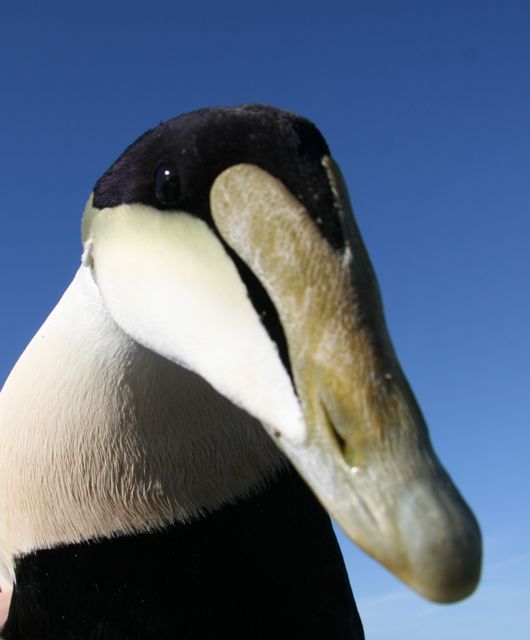
Our target for this week - Common Eider

Success! Our first bird on day one was previously banded in Nova Scotia in 2004.

A hen makes her approach and hits the net.


A drake trapped in the net. 

Sunrise - 3/17/11

Some eiders that made it over the net.

mug shot

Gotta love when the anchor hooks a cluster of blue mussels. I wonder why the eiders are there!
Before

and after!


Wednesday, March 9, 2011

Wildlife Photos

Here are a some wildlife photos I have taken over the past few years around the States.  I am fortunate enough to be outside enough to see some things a lot of people don't.  I always try to have the camera ready when I'm on the road, on the water, or in the woods.


Whitetail Deer - Barry, Illinois

Red Fox  - West Kingston, RI

Brown Bear - Goodnews Bay, Alaska (published 2009 and 2010 Fodor's Alaska Travel Guide)

American Bullfrog - North Kingstown, RI


Harbor Seal - Pawcatuck, CT

Muskrat - West Kingston, RI

Ruby Throated Hummingbird - Richmond, RI

Bald Eagle - Goodnews Bay, Alaska (published 2009 Fodor's Alaska Travel Guide)


Friday, March 4, 2011

Winning!

...In a duck trapping sense.  While trapping has still been slow numbers wise, we had a great week.  The first bonus was a new species.  On Tuesday we trapped two drake american wigeon, it was nice to finally trap something besides a mallard, a black duck, or a cross between the two.


On friday we started the morning with a "new" tactic for winter banding; shooting a large net over the birds (the rest of the crew used this tactic this summer, and it has been used to trap waterfowl for many years.) The net captured a handful of birds, including another new bird for us, a mallard-pintail hybrid! This bird was definitely more of mallard, but showed several characteristics of being partially pintail.


Friday's second high point was a trap full of black ducks which turned out to be more than we had ever caught in a single trap.  In total there were fourteen black ducks in the trap. Two were birds we banded last winter and one about a week ago, leaving eleven brand new black ducks. There were a few mallards in the trap too.

A couple more photos from the week:

Jay and I got out shed hunting again earlier in the week and found a few.


A Rhode Island relic. It looks like the can Quint finished in Jaws and dropped on the deck!


Some early morning green wings.

And finally a red tailed hawk who likes to hang out outside one of our duck traps.

Sunday, February 27, 2011

Some Ducks

Over the past few years I have had the opportunity to visit the Livingston Ripley Waterfowl Conservancy several times. Located in Litchfield CT, the LRWC is an aviary housing waterfowl from around the world.  It is an excellent place to view, photograph, and learn more about various species of birds. I generally take an inordinate amount of photos on each trip and although the LRWC is full of exotic foreign species, my focus always seems to land on the north american birds we are mostly familiar with.

For more info on the aviary: lrwc.net

Here are a few of the photos I have shot there.

Drake canvasback

ruddy ducks and lesser scaup

Drake wood duck close-up

Hen wood duck portrait

Another close up. Hen ruddy duck

Gadwall pair

Drake pintail

Drake green winged teal portrait

A sight I'd like to see in the wild someday. King and spectacled eider with a few other sea ducks in the mix.