Thursday, March 17, 2011

Mist Netting - Common Eiders

Out of all the waterfowl species in North America, the least is known about sea ducks.  Research is difficult because the birds spend much of their lives on the ocean and breed in hard to reach, arctic regions.  Efforts are increasing every year though, and biologists are learning more.

Rhode Island is the winter home to several sea duck species. Common eider, surf, black, and white-wing scoter, oldsquaw, and harlequin ducks are all winter regulars along the coast of new england. Last year we began attempting to catch a few.  Our most successful method was using a large "mist" net, spanned across a stretch of water, surrounded by decoys to lure the birds in close. The birds see the decoys, attempt to land with them, then hit and get tangled in the net.  There was certainly a learning curve involved with setting the nets and getting the birds to play ball, but a year or so of experience is certainly showing. 

With black duck trapping about done for the season, we decided to take advantage of some fair weather this week and go on a couple trips for fun.  We split up and scoured the coast for sea ducks, Josh came back with the best report: 1500-2000 eider in a shallow rocky area right near shore and short run from a boat ramp. Perfect! 

Day one (Tuesday) went well. Everything went smooth and we were able to trap 8 common eider, 2 of which were previously banded. A complete lack of wind and bright sun made the nets stand out and the birds became quickly wary. 

Day two (Thursday) went amazing! Setting the net using two rock piles as a funnel and a little more breeze to hide the net and help direct the birds helped us catch 35 eider.  Again 2 of the birds were previously banded.  

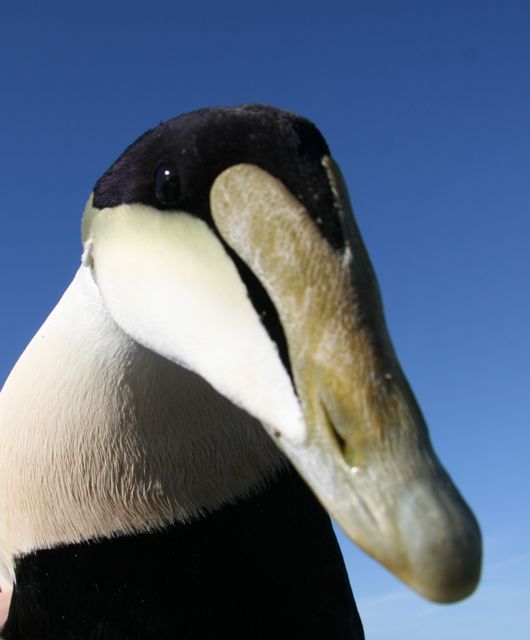
Our target for this week - Common Eider

Success! Our first bird on day one was previously banded in Nova Scotia in 2004.

A hen makes her approach and hits the net.


A drake trapped in the net. 

Sunrise - 3/17/11

Some eiders that made it over the net.

mug shot
Gotta love when the anchor hooks a cluster of blue mussels. I wonder why the eiders are there!
Before

and after!


Wednesday, March 9, 2011

Wildlife Photos

Here are a some wildlife photos I have taken over the past few years around the States.  I am fortunate enough to be outside enough to see some things a lot of people don't.  I always try to have the camera ready when I'm on the road, on the water, or in the woods.


Whitetail Deer - Barry, Illinois

Red Fox  - West Kingston, RI

Brown Bear - Goodnews Bay, Alaska (published 2009 and 2010 Fodor's Alaska Travel Guide)

American Bullfrog - North Kingstown, RI


Harbor Seal - Pawcatuck, CT

Muskrat - West Kingston, RI

Ruby Throated Hummingbird - Richmond, RI

Bald Eagle - Goodnews Bay, Alaska (published 2009 Fodor's Alaska Travel Guide)


Friday, March 4, 2011

Winning!

...In a duck trapping sense.  While trapping has still been slow numbers wise, we had a great week.  The first bonus was a new species.  On Tuesday we trapped two drake american wigeon, it was nice to finally trap something besides a mallard, a black duck, or a cross between the two.


On friday we started the morning with a "new" tactic for winter banding; shooting a large net over the birds (the rest of the crew used this tactic this summer, and it has been used to trap waterfowl for many years.) The net captured a handful of birds, including another new bird for us, a mallard-pintail hybrid! This bird was definitely more of mallard, but showed several characteristics of being partially pintail.


Friday's second high point was a trap full of black ducks which turned out to be more than we had ever caught in a single trap.  In total there were fourteen black ducks in the trap. Two were birds we banded last winter and one about a week ago, leaving eleven brand new black ducks. There were a few mallards in the trap too.

A couple more photos from the week:

Jay and I got out shed hunting again earlier in the week and found a few.


A Rhode Island relic. It looks like the can Quint finished in Jaws and dropped on the deck!


Some early morning green wings.

And finally a red tailed hawk who likes to hang out outside one of our duck traps.

Sunday, February 27, 2011

Some Ducks

Over the past few years I have had the opportunity to visit the Livingston Ripley Waterfowl Conservancy several times. Located in Litchfield CT, the LRWC is an aviary housing waterfowl from around the world.  It is an excellent place to view, photograph, and learn more about various species of birds. I generally take an inordinate amount of photos on each trip and although the LRWC is full of exotic foreign species, my focus always seems to land on the north american birds we are mostly familiar with.

For more info on the aviary: lrwc.net

Here are a few of the photos I have shot there.

Drake canvasback

ruddy ducks and lesser scaup

Drake wood duck close-up

Hen wood duck portrait

Another close up. Hen ruddy duck

Gadwall pair

Drake pintail

Drake green winged teal portrait

A sight I'd like to see in the wild someday. King and spectacled eider with a few other sea ducks in the mix.

Friday, February 25, 2011

Signs of Spring

February is almost gone. Daytime temperatures have been generally warmer and although the nights are still cold, the first signs of spring are showing. The disappearing snow is making way for the first plants of the year to sprout through.  I have noticed skunk cabbage in various streambeds while looking for shed antlers and snowdrops are pushing through in front of the office.  As waterfowlers we have been noticing it as well.  Keeping our eyes peeled to the marshes and opening fresh water we have seen several species that let us know spring is on the way.  While the strong winter numbers remain, wood ducks, teal, and ringnecks have all been coming through in noticeable numbers.  We have also seen several woodcock (a small migratory upland bird) feeding on the roadside in brushy areas.

Woodcock 

Ringnecks and  a Lesser Scaup (far left bird)

Green winged teal drake flyby. 


We have been continuing to band ducks, although our success rate has been a little lower than the initial couple weeks.  Full traps seem to be a thing of the past and we are beginning to prepare for some new tactics using large propelled nets that we shoot over groups of birds.  We will also be heading out on the big water to trap sea ducks.


Jay and a hen black.


A Canadian canada goose that we caught in one of our traps. Banded in Newfoundland and Labrador!


A nice sunrise view of the Newport bridge earlier this week.


Sunday, February 20, 2011

Antlers Somewhere

Each winter male whitetail deer shed their antlers between December and February to make room for new (generally larger) antlers.  There is no rhyme or reason to where deer lose their antlers.  They can fall off while a deer is sleeping, feeding, walking, running, jumping, or just standing still. Sometimes they get knocked off from thick brush,  and sometimes deer expedite the process by rubbing them on a tree or sticking them in mud.

What happens to the antlers? Most become food for mice, squirrels, and other rodents, but a few can be found before it's too late. With hunting season gone and a couple months left until fishing comes into full swing,  "shed hunting" helps fill in some of the down time, it helps keep us active, and helps us scout properties for future deer seasons.

Although some people make it look easy, I have never been very successful at this game. Until this winter I have only found two shed antlers, both incidentally while tracking shot deer, and both had already been found by hungry rodents.  Even though it's definitely not my niche, I still go searching every winter.  I love being in the woods, regardless of what I find... Although a couple antlers every now and then would be nice! 

I have gone on quick walks a couple times this winter, but this past Saturday a few of us spent several hours in the woods in a couple spots loaded with deer.  John struck first, then second soon after with two right side antlers, both under cedar thickets.  The first was from a nice deer, likely an eight-point if the other side matched, and the second was a large spike horn.  A little later on I actually found one myself!  A heavy six point right side (again assuming the other side matched).  We spent a couple more hours looking, but came up empty handed minus a few random deer bones scattered in the woods. 

The successful shed hunt was followed with venison backstrap on the grill and couple cold beers. 

I'm not a fan of litter, but it can make for some cool finds in the woods.

Deer tracks in the snow.

A buck rub from this past fall. 

An unfortunate downside to a hard winter. The coyotes win one every now and then.


Sunday, February 13, 2011

Rhode Island late geese - Final Day

Some photos from the final day of the late goose season. It was another good one.


We call Kyle pop tart for a reason.

Jay flagging to a far off flock

Jim and George getting up to shoot.

Kyle shooting.

The Pile.

Unique goose wing.